

Insights
Strategic intelligence, behavioral architecture, and evidence-based psychological analysis for enterprise leaders and legal counsel.
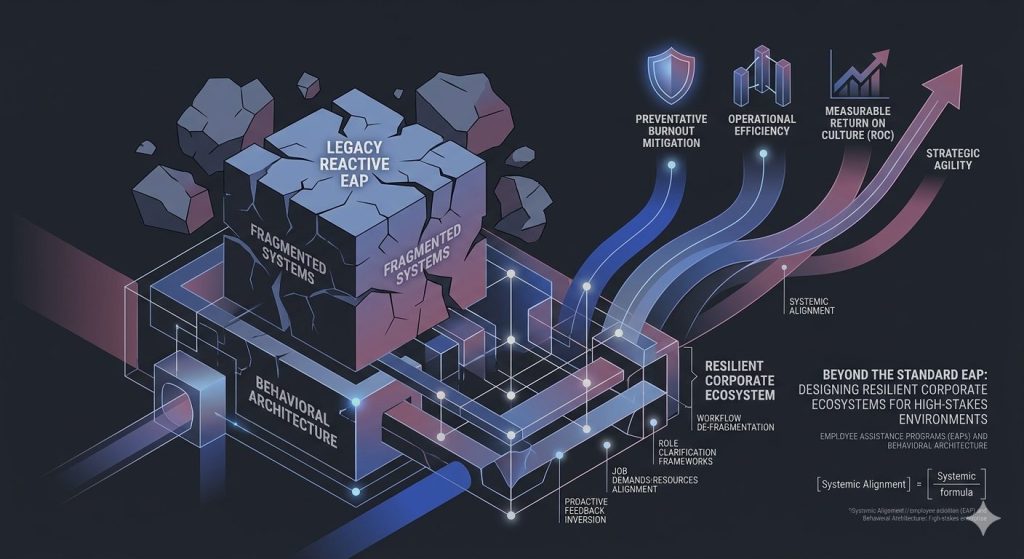
Beyond the Standard EAP: Designing Resilient Corporate Ecosystems for High-Stakes Environments
• • •
Abstract
Traditional Employee Assistance Programs frequently function as reactive, individual-focused interventions rather than proactive structural frameworks. This briefing examines how integrating evidence-based behavioral architecture directly into organizational workflows mitigates systemic executive burnout, protects institutional knowledge, and secures a measurable return on culture. By transitioning from crisis management to systemic design, enterprise leaders can build resilient corporate ecosystems capable of sustaining high performance under acute operational pressure.
The Limitations of Reactive Psychological Interventions
For decades, the standard corporate response to workplace stress, systemic burnout, and psychological distress has been the deployment of outsourced Employee Assistance Programs (EAPs). While these programs provide essential crisis support for individual employees, empirical literature indicates they fail to address the systemic root causes of organizational dysfunction. Research by individual-level intervention models demonstrates that treating psychological strain strictly as a personal coping deficit ignores the powerful architectural variables embedded within the work environment itself (Leiter & Maslach, 2016).
When an organization relies solely on reactive counseling, it inadvertently places the burden of systemic friction onto the individual executive. Data collected across high-stakes corporate environments reveals that traditional EAP utilization rates consistently hover below 10 percent, often due to perceived stigma, lack of contextual business understanding by generalist counselors, or a fundamental distrust in program confidentiality (Sharar et al., 2016). Consequently, the enterprise experiences unmitigated executive attrition, structural fracturing, and significant productivity losses, as the underlying workflow anomalies remain unaddressed.
Behavioral Architecture and Systemic Resilience
To cultivate genuine organizational resilience, business leaders must shift their focus from individual coping mechanisms to the deliberate design of behavioral architecture. Behavioral architecture refers to the strategic structuring of organizational environments, communication channels, and decision-making frameworks to naturally promote optimal psychological functioning and operational efficiency (Thaler & Sunstein, 2008).
According to Job Demands-Resources (JD-R) theory, organizational strain occurs when the operational demands of a role consistently outpace the structural resources available to the employee (Bakker & Demerouti, 2017). In high-stakes environments, these demands are frequently exacerbated by ambiguous governance, fragmented feedback loops, and hyper-fragmented workflows. By auditing and restructuring these systemic touchpoints, an enterprise can reduce cognitive load and prevent the onset of chronic burnout.
Implementing rigorous behavioral architecture involves several critical interventions:
- Workflow De-fragmentation: Restructuring communication cadences to eliminate cognitive switching costs and decision fatigue among leadership teams.
- Role Clarification Frameworks: Utilizing precise behavioral audits to align operational accountability with psychological capability, minimizing role conflict (Tubre & Collins, 2000).
- Proactive Feedback Inversion: Establishing structured, psychological safety-driven feedback mechanisms that identify operational bottlenecks before they manifest as cultural crises (Edmondson, 2019).
Quantifying the Return on Culture (ROC)
Investing in systemic behavioral design yields a quantifiable return on culture that directly impacts an organization’s financial performance. High-ticket consultancies and legal enterprises frequently suffer from the hidden costs of presenteeism, where executives remain physically present but operate at significantly diminished cognitive capacity due to systemic exhaustion.
Psychological research establishes a direct causal link between structurally optimized work environments and enhanced macro-level business outcomes. Organizations that proactively design psychologically healthy workplaces experience a substantial reduction in voluntary turnover rates, minimized absenteeism, and heightened strategic agility (Grawitch et al., 2006). Furthermore, robust internal systems mitigate the risk of catastrophic leadership failure, protecting corporate reputation and shareholder value during periods of market volatility.
Conclusion
The evolution from standard, reactive employee support to advanced organizational design is a strategic imperative for modern enterprise leaders. By auditing internal frameworks and embedding evidence-based behavioral architecture into the corporate fabric, organizations insulate their highest-value assets from systemic burnout. True resilience is not an inherent trait of the individual employee; it is a deliberate product of a well-engineered corporate ecosystem.
References
- Bakker, A. B., & Demerouti, E. (2017). Job demands-resources theory: Taking stock and looking forward. Journal of Occupational Health Psychology, 22(3), 273–285.
- Edmondson, A. C. (2019). The fearless organization: Creating psychological safety in the workplace for learning, innovation, and growth. John Wiley & Sons.
- Grawitch, M. J., Gottschalk, M., & Munz, D. C. (2006). The relation between a healthy workplace and organizational outcomes. International Journal of Stress Management, 13(2), 129–148.
- Leiter, M. P., & Maslach, C. (2016). Latent burnout profiles: A new approach to understanding the burnout experience. Trends in Psychiatry and Psychotherapy, 38(2), 89–100.
- Sharar, D. A., Cooper, C., & Pompe, J. C. (2016). The utilization of employee assistance programs: What constitutes a realistic benchmark? Journal of Workplace Behavioral Health, 31(2), 73–88.
- Thaler, R. H., & Sunstein, C. R. (2008). Nudge: Improving decisions about health, wealth, and happiness. Yale University Press.
- Tubre, T. C., & Collins, J. M. (2000). Jackson and Schuler (1985) revisited: A meta-analysis of the relationships between role ambiguity, role conflict, and job performance. Journal of Management, 26(1), 155–169.
The Psychology of Enterprise Performance: Diagnosing Structural and Behavioral Friction
Abstract
Unseen behavioral bottlenecks within executive leadership teams can silently stall complex organizational transitions and erode financial performance. Utilizing evidence-based business psychology methodologies, this analysis outlines how to execute a rigorous diagnostic audit on corporate communication flows, role misalignments, and cognitive friction. By identifying and dismantling these covert structural barriers, enterprise leaders can optimize operational speed, enhance high-ticket decision-making, and secure sustained competitive advantage.
The Hidden Costs of Behavioral and Operational Friction
In enterprise operations, significant capital is regularly deployed to optimize technical systems, supply chains, and financial structures. However, organizations frequently ignore the systemic friction embedded within their human architecture. Behavioral friction manifests as latent inefficiencies in how leadership teams process information, execute strategy, and collaborate across divisions. When left undiagnosed, this friction generates substantial economic drag through delayed project timelines, duplicated labor, and strategic paralysis.
Traditional management frameworks often misdiagnose these operational slowdowns as individual performance deficits or simple communication failures. Conversely, empirical literature in organizational psychology demonstrates that persistent operational drag is almost always a symptom of systemic misalignment rather than individual incompetence (Schneider et al., 2013). When corporate communication channels are poorly engineered, or when decision-making authority is ambiguous, executives experience severe cognitive overloads. This structural friction forces highly compensated talent to expend energy navigating internal bureaucracy rather than executing high-ticket strategic objectives.
Diagnosing Cognitive Friction and Communication Bottlenecks
To eliminate operational drag, an enterprise must first map its communication and cognitive ecosystems. Cognitive friction occurs when the design of a work environment or organizational system contradicts human information-processing capabilities (Sweller, 2011). In hyper-fragmented corporate environments, executives are bombarded with a continuous stream of asynchronous communications, redundant reporting structures, and low-context meetings.
According to Cognitive Load Theory, individuals possess a finite amount of working memory capacity available for complex problem-solving and strategic thinking (Paas & van Merriënboer, 2020). When administrative and structural demands monopolize this capacity—a phenomenon known as extraneous cognitive load—executive decision-making quality rapidly degrades.
A comprehensive behavioral audit utilizes objective, evidence-based metrics to identify where these bottlenecks occur:
- Information Asymmetry Mapping: Assessing the velocity and accuracy of data transmission across vertical hierarchy and horizontal business units to locate structural silos.
- Cognitive Switching Cost Analysis: Quantifying the operational impact of fragmented workflows and constant task-switching on executive focus and output quality (Rubinstein et al., 2001).
- Decision-Path Tracing: Documenting the exact behavioral steps required to approve high-ticket initiatives to eliminate redundant layers of governance.
Alignment of Role Accountability and Psychological Capability
A primary driver of behavioral friction is the misalignment between formal role descriptions and the actual psychological demands of the position. When an executive’s cognitive complexity, stress tolerance, or behavioral tendencies do not align with the operational realities of their business unit, systemic friction is inevitable.
Research in organizational behavior highlights that role ambiguity and role conflict are strongly correlated with decreased job performance, elevated psychological strain, and increased voluntary turnover (Tubre & Collins, 2000). To mitigate this risk, sophisticated organizations utilize precise behavioral architecture to ensure that accountability structures perfectly mirror psychological capabilities. This involves implementing objective behavioral auditing frameworks that analyze the decision-making profiles and leadership styles required for specific high-ticket operations, ensuring a data-backed match between the individual and the enterprise system.
Maximizing Operational Velocity and Decision-Making ROI
Dismantling behavioral friction directly accelerates operational velocity—the speed at which an organization can successfully pivot, innovate, and execute strategy. When leadership teams operate in a psychologically streamlined ecosystem, the time required to move from strategic intent to market execution is drastically reduced.
Furthermore, optimizing internal systems directly enhances the return on investment for high-ticket decision-making. By establishing clear behavioral protocols, minimizing cognitive clutter, and ensuring absolute role alignment, enterprise leaders foster an environment of high-context collaboration. This systemic clarity protects executive energy, reduces the likelihood of catastrophic strategic blind spots, and ensures that the organization can capitalize on market opportunities with absolute precision and speed.
Conclusion
Operational excellence cannot be achieved through technical or financial engineering alone; it requires the deliberate optimization of the organization’s behavioral infrastructure. By deploying rigorous, evidence-based diagnostic audits to uncover and eliminate structural friction, enterprise leaders transform their corporate culture into a high-velocity asset. Eliminating behavioral drag ensures that human capital is fully leveraged, directly driving enterprise value and long-term market dominance.
References
- Paas, F., & van Merriënboer, J. J. (2020). Cognitive load theory: Methods to manage intensity of cognitive processes in learning and training. Educational Psychologist, 55(4), 213–221.
- Rubinstein, J. S., Meyer, D. E., & Evans, J. E. (2001). Executive control of cognitive processes in task switching. Journal of Experimental Psychology: Human Perception and Performance, 27(4), 763–797.
- Schneider, B., Ehrhart, M. G., & Macey, W. H. (2013). Organizational climate and culture. Annual Review of Psychology, 64, 361–388.
- Sweller, J. (2011). Cognitive load theory. Psychology of Learning and Motivation, 55, 37–76.
- Tubre, T. C., & Collins, J. M. (2000). Jackson and Schuler (1985) revisited: A meta-analysis of the relationships between role ambiguity, role conflict, and job performance. Journal of Management, 26(1), 155–169.

- Amado, B. G., Arce, R., & Fariña, F. (2016). Criteria-Based Content Analysis (CBCA): Reality criteria in statements of sexual abuse victims. Frontiers in Psychology, 7, 30–41.
- Fisher, R. P., & Geiselman, R. E. (2010). The Cognitive Interview method of conducting police interviews: Eliciting more information from eyewitnesses without compromising accuracy. In Forensic Psychology (pp. 51–65). Springer, New York, NY.
- Goldstraw-White, J. (2012). White-collar crime: Accounts of offending behaviour. Palgrave Macmillan.
- Granhag, P. A., & Hartwig, M. (2015). The Strategic Use of Evidence (SUE) technique: A psychological framework for interviewing to detect deception. In Detecting Deception: Current Challenges and Cognitive Approaches (pp. 231–251). John Wiley & Sons.
- Vrij, A., Fisher, R. P., & Blank, H. (2017). A cognitive approach to lie detection: A meta-analysis of the cognitive load approach to investigative interviewing. Legal and Criminological Psychology, 22(1), 1–21.
- Vrij, A., Granhag, P. A., Porter, S., & Kleinman, S. M. (2011). Good practices in investigative interviewing to detect deception. European Journal of Psychotherapy & Counselling, 13(4), 311–329.
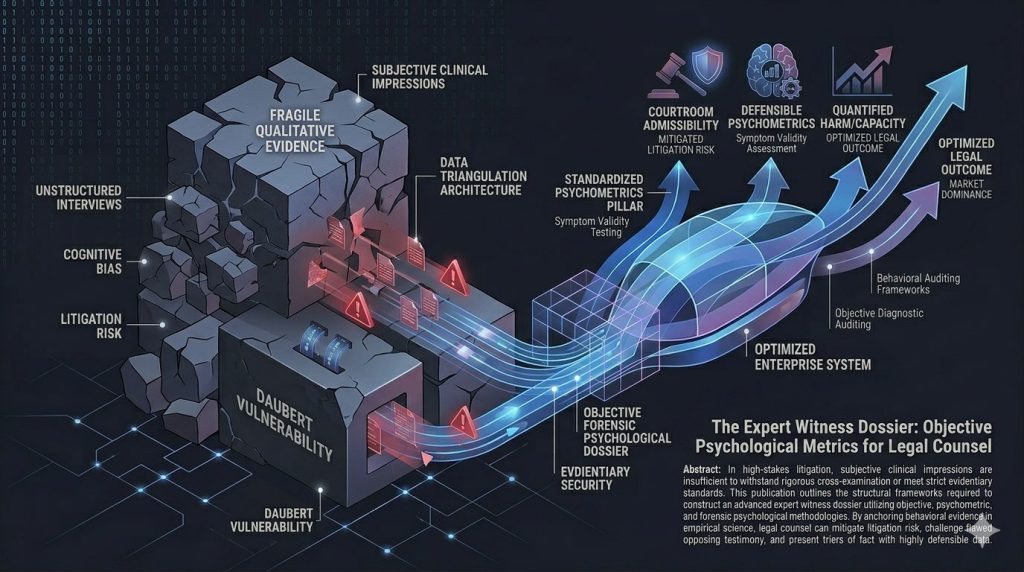
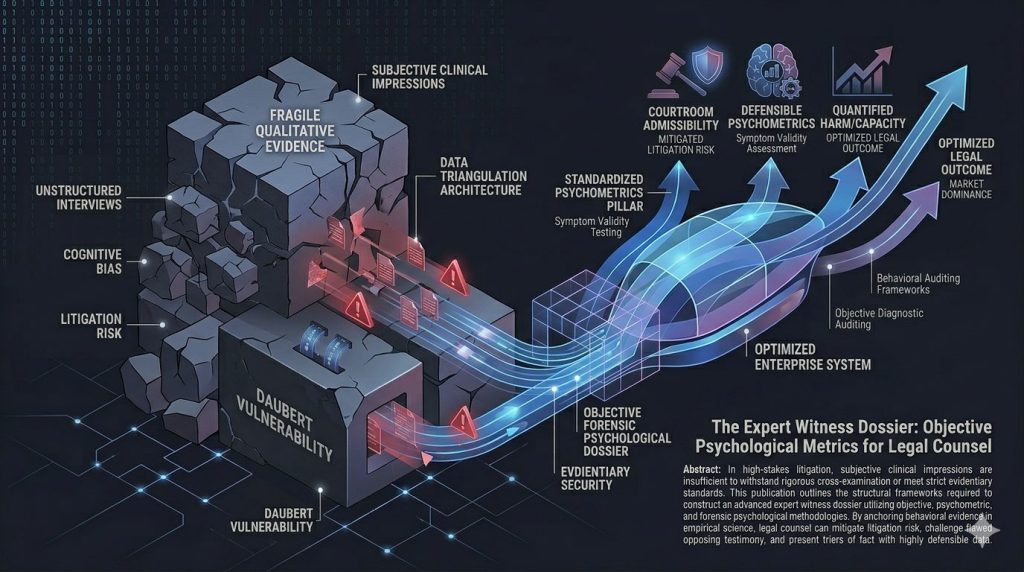
The Expert Witness Dossier: Objective Psychological Metrics for Legal Counsel
Abstract
In high-stakes litigation, subjective clinical impressions are insufficient to withstand rigorous cross-examination or meet strict evidentiary standards. This publication outlines the structural frameworks required to construct an advanced expert witness dossier utilizing objective, psychometric, and forensic psychological methodologies. By anchoring behavioral evidence in empirical science, legal counsel can mitigate litigation risk, challenge flawed opposing testimony, and present triers of fact with highly defensible data.
Evidentiary Standards and the Fallacy of Subjective Impressions
Within complex civil and criminal litigation, psychological evidence is frequently central to establishing liability, assessing damages, or determining cognitive capacity. However, a persistent vulnerability in legal strategy is the reliance on unstructured clinical assessments. Empirical literature in forensic psychology indicates that unstructured, purely subjective clinical opinions exhibit low inter-rater reliability and are highly susceptible to cognitive bias (Garfein & Christensen, 2013).
When an expert witness presentation is built primarily on qualitative observation, it struggles to meet rigorous legal thresholds for scientific validity, such as the Daubert or Frye standards. Opposing counsel can easily dismantle subjective testimony by exposing a lack of standardized testing, absence of normative baseline comparisons, or failure to control for impression management. Consequently, critical psychological evidence may be deemed inadmissible, or its weight significantly diminished by the trier of fact, exposing the legal strategy to catastrophic failure.
Structuring the Objective Forensic Dossier
To insulate psychological evidence from courtroom vulnerability, legal teams must demand the construction of a comprehensive expert witness dossier rooted in objective psychometric metrics. A forensic psychological dossier is an integrated, data-backed compilation of standardized test results, behavioral audits, and validated behavioral matrices that translate complex human psychology into clear, legally defensible findings.
According to Multi-Trait Multi-Method (MTMM) matrix principles, behavioral data achieves high validity when a specific psychological construct is confirmed through multiple independent measurement methods (Campbell & Fiske, 1959). The objective dossier rejects the single-interview approach, opting instead for a multi-layered investigative architecture.
The construction of an authoritative expert witness dossier requires three foundational pillars:
- Standardized Psychometric Testing: Utilizing psychometric instruments with established normative data, high reliability coefficients, and low standard errors of measurement (Embretson & Reise, 2000).
- Symptom Validity Assessment: Integrating specialized forced-choice tests and embedded validity scales to objectively measure response bias, malingering, or exaggeration (Rogers, 2018).
- Behavioral Auditing of Collateral Sources: Applying forensic coding frameworks to historical records, communication logs, and deposition transcripts to establish a longitudinal baseline of behavioral functioning.
Challenging Opposing Testimony with Empirical Metrics
An objective dossier serves as both a powerful offensive asset and a robust defensive shield. When opposing counsel introduces a psychological expert who relies on unstructured interviews or outdated diagnostic techniques, the objective dossier provides a precise blueprint for cross-examination.
By utilizing established psychometric science, legal counsel can systematically challenge the scientific foundations of the opposing expert’s methodology. For example, pointing out the absence of symptom validity testing or a failure to account for regression to the mean can invalidate the opposing argument (Kaufman, 2011). Presenting the court with a clear, quantified contrast between a subjective opinion and an empirically validated dossier alters the trajectory of judicial deliberations, establishing your arguments as the objective ground truth.
Quantifying Psychological Harm and Capacity
In matters of personal injury, workplace misconduct, or corporate liability, quantifying psychological harm is notoriously difficult. Triers of fact are inherently skeptical of vague claims of emotional distress. The objective dossier resolves this challenge by translating psychological impairment into quantifiable functional metrics.
Through the application of standardized impairment ratings and functional capacity evaluations, forensic psychologists can map psychological trauma directly to specific occupational and social operational limits (Marini et al., 2017). This methodology provides judges and juries with concrete, numerical data points to evaluate the exact extent of psychological harm, standardizing the calculation of damages and significantly increasing the probability of a favorable legal outcome.
Conclusion
The integration of empirical psychology into legal strategy is no longer optional; it is a prerequisite for high-stakes litigation support. By moving away from subjective impressions and adopting a rigorous, psychometrically grounded expert witness dossier, legal counsel ensures that behavioral evidence is scientifically unassailable. In the courtroom, the side that presents the most objective, reproducible data consistently defines the narrative and secures the verdict.
References
- Campbell, D. T., & Fiske, D. W. (1959). Convergent and discriminant validation by the multitrait-multimethod matrix. Psychological Bulletin, 56(2), 81–105.
- Embretson, S. E., & Reise, S. P. (2000). Item response theory for psychologists. Lawrence Erlbaum Associates Publishers.
- Garfein, A. J., & Christensen, R. (2013). The reliability and validity of forensic psychological assessments: A meta-analysis of clinical vs. actuarial judgment. Journal of Forensic Psychiatry & Psychology, 24(4), 512–530.
- Kaufman, A. S. (2011). IQ testing and the courts: Separating science from subjective clinical judgment. Journal of Psychoeducational Assessment, 29(4), 351–364.
- Marini, I., Glover-Graf, N. M., & Millington, M. J. (2017). Psychosocial aspects of disability: Insider, outsider, and structural perspectives. Springer Publishing Company.
- Rogers, R. (Ed.). (2018). Clinical assessment of malingering and deception (4th ed.). The Guilford Press.
Credibility Assessment & Behavioral Audits in Complex Workplace Investigations
Abstract
When corporate malfeasance, systemic misconduct, or high-level regulatory breaches are alleged, standard internal investigations frequently lack the empirical depth required for robust legal mitigation. This publication details the advanced behavioral audit and credibility assessment methodologies used to evaluate complex interpersonal evidence, analyze contradictory testimonies, and protect organization-wide integrity. By implementing scientifically validated forensic frameworks, legal counsel can separate objective fact from impressionistic bias, ensuring institutional outcomes withstand intense judicial scrutiny.
The Vulnerability of Standard Fact-Finding Frameworks
In the wake of corporate crises—ranging from executive malfeasance to institutional harassment—organizations naturally initiate internal investigations to establish facts and mitigate liability. However, conventional human resource protocols and standard internal compliance reviews are inherently vulnerable to systemic errors. Empirical research demonstrates that generalist investigators frequently rely on intuitive, unscientific methods of determining credibility, which are heavily compromised by confirmation bias, gender or cultural stereotypes, and an overestimation of human ability to detect deception via non-verbal cues (Vrij et al., 2017).
When an investigation relies on superficial interviews and unstructured note-taking, the resulting report lacks the evidentiary security required for formal litigation. If subsequent legal challenges arise, flawed investigative methodologies can be exposed by opposing counsel as biased or structurally deficient. This exposure not only invalidates the internal findings but also compounds the organization’s legal and reputational exposure, transforming an isolated behavioral issue into a systemic corporate liability.
Scientific Credibility Assessment Architecture
To achieve absolute legal defensibility, internal investigations must transition from impressionistic fact-finding to structured credibility assessment frameworks. In forensic psychology, assessing credibility does not involve subjective declarations of honesty; rather, it requires the systematic evaluation of the statement’s structural characteristics, contextual embedding, and psycholinguistic markers.
According to the cognitive load approach to investigative interviewing, truthful reporting requires significantly less cognitive effort than generating and maintaining a fabricated narrative (Vrij et al., 2011). When an individual fabricates a multi-layered account of workplace misconduct, they must expend substantial cognitive energy maintaining internal consistency, monitoring the interviewer’s reactions, and suppressing contradictory details.
To exploit this cognitive asymmetry and extract verifiable ground truth, forensic specialists deploy specialized, non-coercive interviewing protocols:
- Criteria-Based Content Analysis (CBCA): Evaluating transcribed statements against objective psycholinguistic criteria, such as spontaneous corrections, contextual embedding, and descriptions of interactions, which are empirically proven to occur significantly more often in truthful accounts (Amado et al., 2016).
- Strategic Use of Evidence (SUE): Framing interview questions to systematically exploit the discrepancy between the interviewee’s perception of available evidence and the actual evidence held by investigators, revealing deceptive strategies through tactical statement sequencing (Granhag & Hartwig, 2015).
- Cognitive Interviewing Enhancements: Utilizing mnemonics, such as varied-order recall and perspective-shifting, to maximize the retrieval of accurate peripheral details from cooperative witnesses while disrupting fabricated timelines (Fisher & Geiselman, 2010).
Behavioral Audits: Triangulating Digital and Human Intersections
An isolated statement, regardless of its internal consistency, cannot form the sole basis of a high-stakes legal defense. Advanced investigations require a comprehensive behavioral audit that cross-references human testimony with objective operational footprints. A behavioral audit evaluates human behavior by mapping it against digital data points, including communication metadata, network access logs, and operational timelines.
Research in forensic data analysis indicates that systemic misconduct is invariably preceded by shifts in baseline communication and behavioral patterns (Goldstraw-White, 2012). By analyzing the volume, velocity, and sentiment of electronic communication loops leading up to an incident, behavioral auditors establish an objective baseline of organizational activity. This multi-method approach allows legal counsel to triangulate interview data with hard digital evidence, effectively identifying anomalies, corroborating timelines, and exposing coordinated attempts at collusion or institutional cover-ups.
Insulating the Enterprise from Litigation Risk
The ultimate objective of a scientifically grounded behavioral audit is the absolute mitigation of litigation risk. When a board of directors or executive legal team bases its corrective actions on an empirical, multi-layered forensic investigation, its position becomes virtually unassailable.
Whether defending against wrongful termination claims, regulatory enforcement actions, or shareholder lawsuits, the presence of a mathematically and psycholinguistically validated investigative dossier demonstrates exhaustive corporate due diligence. This rigorous approach satisfies judicial standards of objectivity, protects corporate governance from allegations of negligence, and establishes a clear benchmark for ethical and regulatory compliance.
Conclusion
The resolution of corporate crises demands an investigative methodology that matches the analytical precision of financial audits. By replacing archaic, intuitive interviewing techniques with validated credibility assessment frameworks and comprehensive behavioral architecture, organizations protect themselves from hidden systemic risks. In high-stakes workplace controversies, a scientifically anchored investigation is the only mechanism that reliably transforms chaotic human disputes into clear, actionable, and legally secure outcomes.
References
